
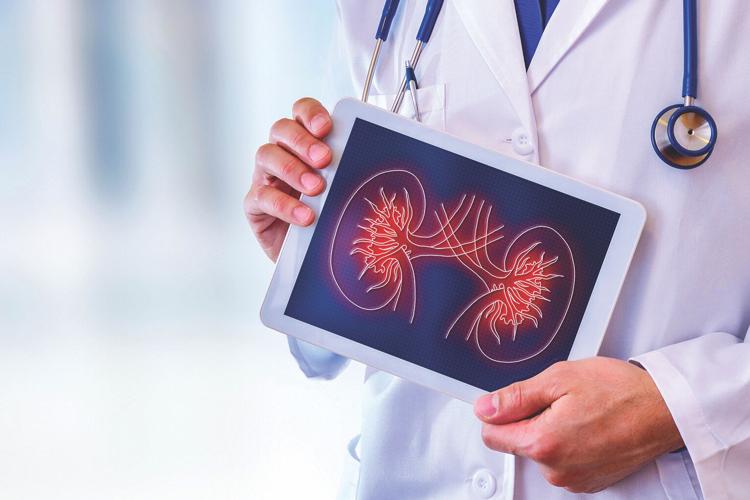
Kidney Health
Advances in chronic kidney disease
The last quarter century has seen significant advances in slowing the rate of progression of kidney failure, along with significant reductions in the rates of cardiovascular deaths, with the advent of four major drug classes, evolving from the results of landmark studies that began in 2001, according to Nephrologist Dr. Adrian Sawyer.
The majority of the medications he said have activity against physiologic systems that control body fluid volume, sodium excretion, blood glucose, and inflammation processes. “Key targets are the systems that are involved in the production of the hormone angiotensin 2, which causes blood vessel constriction, elevated blood pressure, sodium retention, increase in body fluid volume and systemic inflammation, resulting in hypertension and kidney damage, and the activation by angiotensin 2 of receptors in the adrenal glands that also have similar effects via a hormone called aldosterone which activates the mineralocorticoid receptor located in blood vessels, the heart, the brain, the kidney and fat cells,” said Sawyer as Kidney Month is observed.
Kidney Month is more than just an opportunity to raise awareness, it is also an action month to protect and improve kidney health.
World Kidney Day (WKD) was observed on March 14, also with the aim to raise awareness about kidney health and prevention of kidney disease.
Chronic kidney disease (CKD) affects millions of people worldwide, and The Bahamas is no exception. The Bahamas Kidney Association (BKA) exists to educate the public about preventative measures and encourage support for those affected.
Tamika Roberts, BKA president, in a press release, said WKD, which the year had as its theme “Kidney Health For All”, emphasizes the importance of collective action in promoting kidney health.
BKA officials encourage people to learn and share as knowledge is key in the fight against CKD.
“Take the time to educate yourself and others about the risk factors, symptoms, and preventative measures associated with kidney diseases,” the association encourages.
Sawyer said CKD is defined as abnormal kidney structure and/or function that persists for three months or more, clinically manifested as a decline in the glomerular filtration rate (GFR), and increased urine protein (albumin) excretion.
CKD he said currently ranks as the 12th leading cause of death worldwide, and is expected to rank at number five by 2040.
“CKD is estimated to affect 10 to 15 percent of adults worldwide,” he said. “CKD is a significant cause of premature death related to cardiovascular (heart attacks, heart failure, sudden cardiac death, stroke and peripheral vessel obstruction resulting in limb amputation).”
Major diseases causing CKD are diabetes 30 to 45 percent of cases; high blood pressure (hypertension) 20 to 25 percent of cases; cystic kidney disease-familial six to eight percent; glomerulonephritisinflammation affecting the filtering units of the kidneys 10 to 15 percent; infections – HIV, hepatitis B & C, and lupus – in which approximately 50 percent of individuals will have kidney involvement.
CKD is classified in five stages by quantification of estimated glomerular filtration rate (eGFR) stage one through stage five with stage five indicating end stage kidney failure (ESRD) requiring dialysis or kidney transplantation.
“CKD is defined as an eGFR of 60.0 ml/min/1.73m2 or less with increased urine albumin excretion (increasing levels of excretion correlate with increasing risk of acceleration to stage five ESRD and higher cardiovascular disease mortality). Of patients with CKD stage three, only 10 to 15 percent will survive to reach dialysis or transplantation due to the high cardiovascular mortality.
According to Sawyer, in 2001, drugs that treat hypertension by interrupting the formation of angiotensin 2 or blocking its effect at the receptor, were found to reduce kidney damage by 23 to 28 percent, independent of blood pressure lowering effects, resulting in the prolongation/delay in the time to progress to dialysis of approximately two to three years. Medications in the class are enzyme inhibitors: Enalapril, Lisinopril, or the receptor blockers, Telmisartan, Valsartan, Losartan.
Between 2019 and 2023, he said there were three major kidney protection trials using a new class of medications for the treatment of diabetes, that work primarily by blocking the ability of kidneys to reabsorb sodium and glucose from the urine, Canagliflozin, Dapagliflozin and Empagliflozin were found to have beneficial effects for kidney protection and cardiovascular protection in diabetic and non-diabetic kidney disease, across the spectrum of stage two through stage four chronic kidney disease (CKD) with overall kidney failure risk reduction of 37 percent; cardiovascular risk reduction of 23 percent, when added to treatments with medications in the previous paragraph.
The doctor said this added potentially five to seven years in the delay to end stage renal disease (ESRD).
In 2016, he said subsequent analysis of the use of two injectable diabetes medications that work by stimulating target cells in the distal small bowel and colon to activate receptors for Glucogon-like peptide- receptor-1 (GLP-1 receptor agonists) that stimulate the beta cells of the pancreas to produce insulin, inhibit insulin degradation, and promote preservation of beta cells -(LEADER (Liraglutide) and SUSTAIN-6 (Semaglutide) trials). Off target effects, he indicated, include delay in stomach emptying and more impressively, cause inhibition of appetite, resulting in 18 to 22 percent loss of body weight.
“The Danish company responsible for Semaglutide, reached a pinnacle as the most valued company in Europe in the closing months of 2023 due to the high volume of sales of the medication for weight loss. The reduction in kidney outcomes were between 22 percent and 36 percent. The mechanism of kidney protection is currently unclear and conjectural but may add approximately two years to the ESRD progression time. The once weekly injection schedule for Semaglutide may also appeal to patients,” said Sawyer.
In 2022 he said the FIDELITY analysis of two large trials FIDELIO – kidney outcomes and FIGARO cardiovascular outcomes across a wide range of eGFR, demonstrated risk reductions of 23 percent and 20 percent in kidney composite and dialysis end points and 14 percent cardiovascular composite end point risk reduction and 22 percent risk reduction for hospitalization for heat failure. The trials listed from 2016 through 2022 were all undertaken with maximal doses of drugs in class of the 2001 studies (angiotensin 2 inhibitors) as standard background treatment.